The novel writing app that remembers your whole story.
A quiet workspace for long books. Typetoe reads your manuscript and keeps track of every character, place, and decision — so the AI is a first reader, not a ghostwriter. You choose which one, and it never touches a word unless you ask.
Files stay yours, always
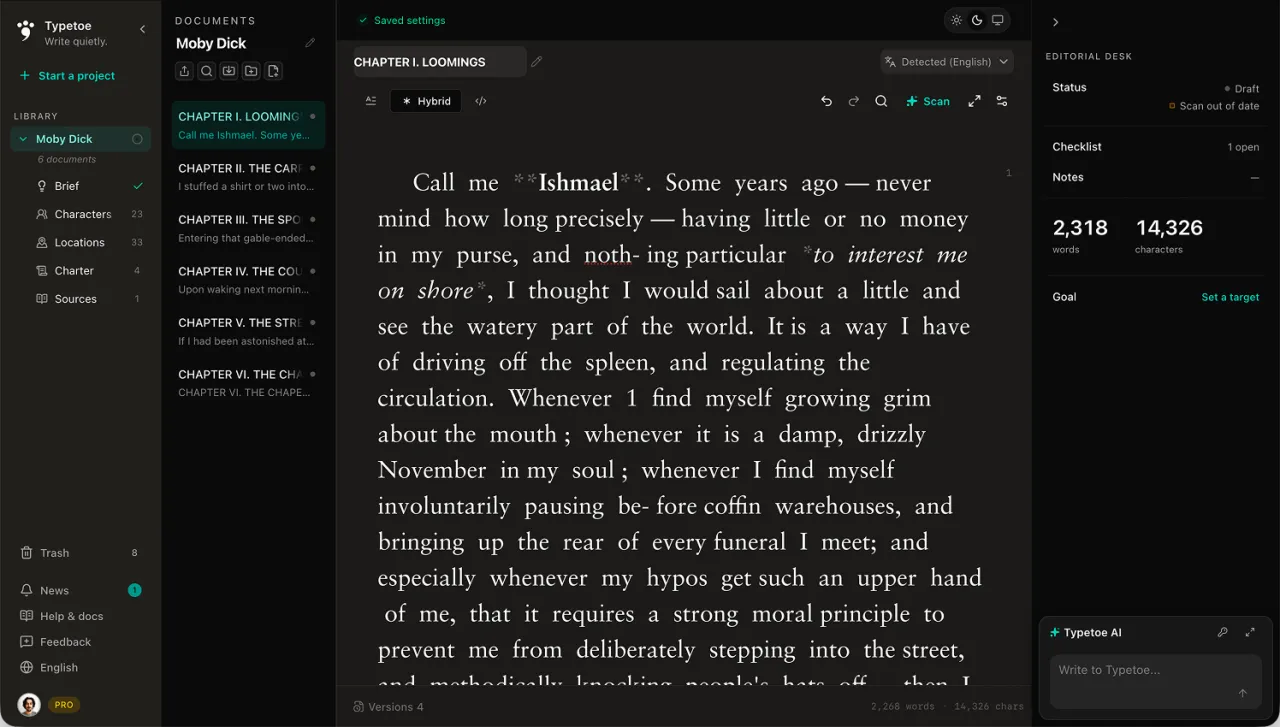
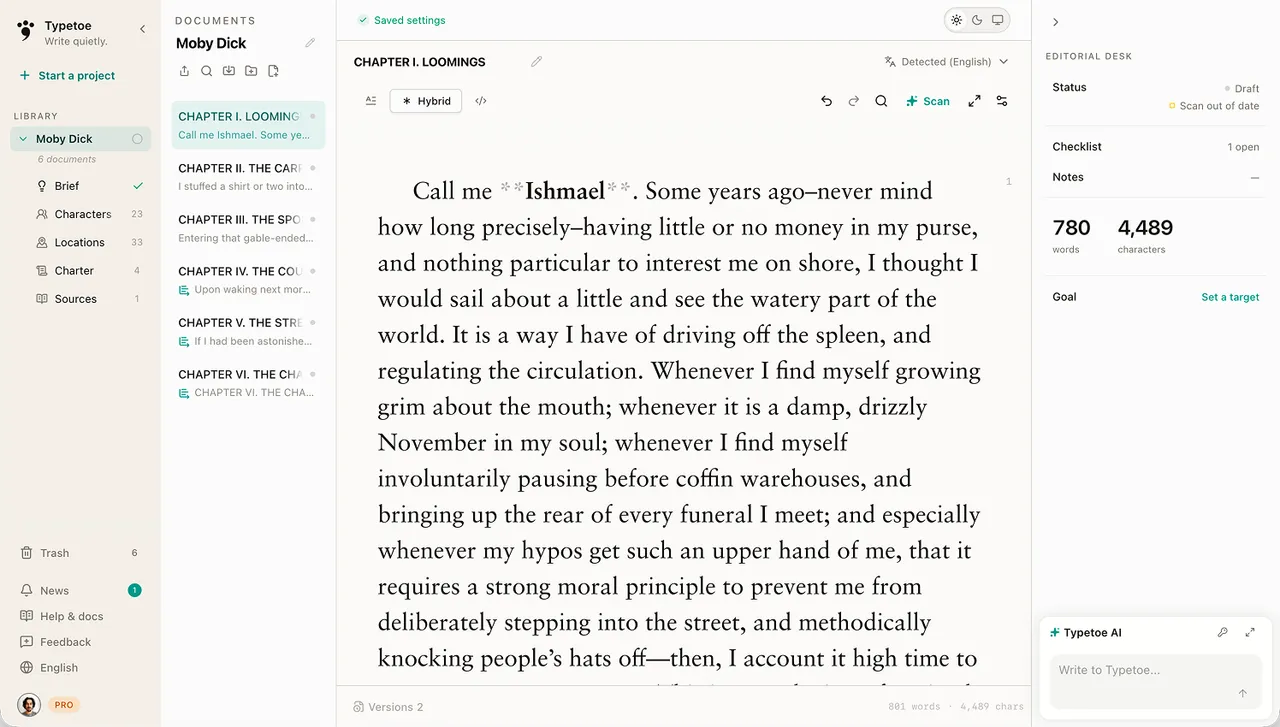
- A story bible that writes itself
- AI included, or bring your own key
- Or connect Claude and ChatGPT
- Every draft kept, forever
- Ask the app, don't hunt the docs
- Web, iPhone and Mac — one library
- Backups to your own Dropbox
- Never trained on your work
- Export everything, anytime
- Focus mode, when the room must go quiet
What is Typetoe?
Typetoe is a clear-eyed, impartial reader, always available. It learns your manuscript and helps you build its story bible from the ground up — characters, places, rules, knots to untangle, outside sources — leaving you free to decide whether, how, and how much to use an AI model, at the cost and in the form you set.
Your workspace
Where creativity meets memory.
Memory
Let Typetoe untangle the threads.
A novel quickly outgrows a single file. Over months of work, chapters, characters, timelines, discarded scenes, sources, and things to verify begin to pile up. Typetoe builds a living memory of the project, so you always know what is canon, what is uncertain, and what still needs your attention.
New character detected
Esther, the midwife
First appears in Chapter I. Jewish midwife in Asnières-sur-Seine; announces Marlène’s birth to the neighbourhood.
Story bible
The story bible that writes itself.
Most writing tools make you fill in a character-and-lore database by hand. Typetoe does the opposite: every time it reads a document, it proposes new characters, locations, rules, and research to-dos as cards. You approve what’s right and dismiss the rest. Your world builds itself while you write.
Your AI, your choice
Three ways to have the AI. All of them yours.
On Typetoe
Every account gets AI without setting anything up.
The scans that build your story bible out of your own text, 25 questions to get started, and two advanced readings — a top model reading a whole chapter and telling you what works and what it promises the reader. Typetoe pays for those, on its own key. Pro raises the scan allowance, the yearly plan adds two readings a month, and packs of five or ten can be bought whenever you want more.
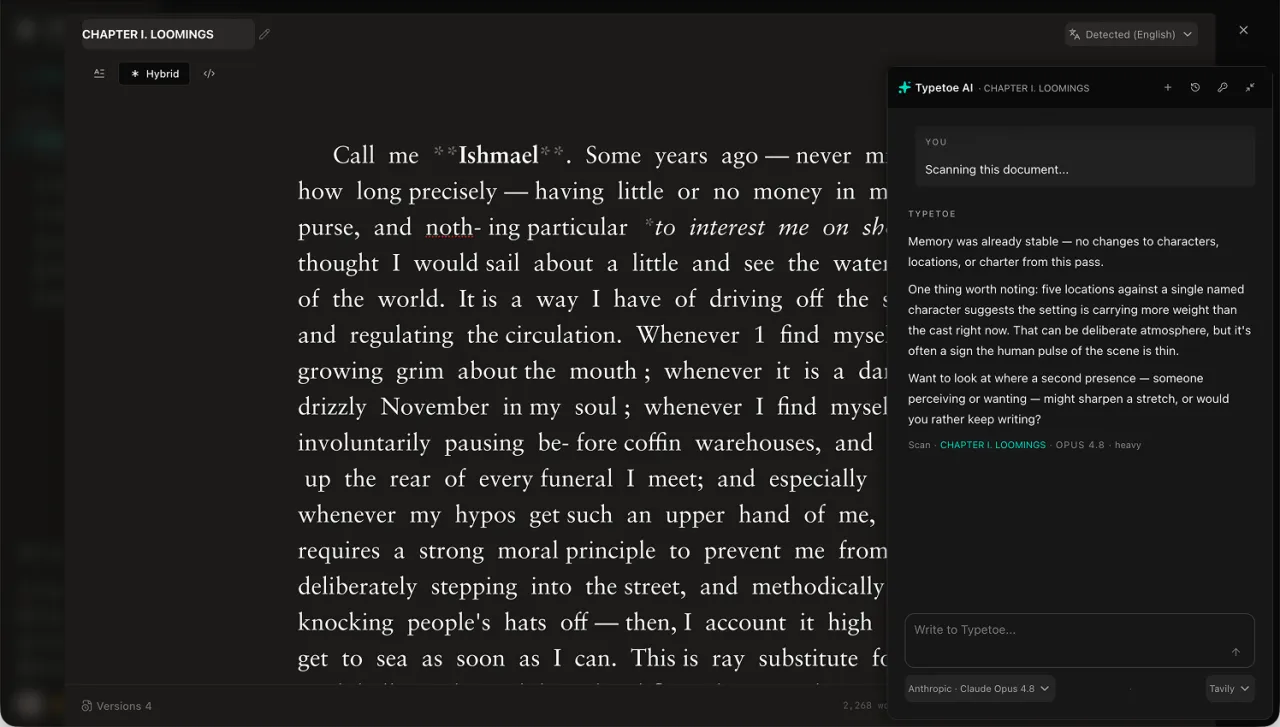
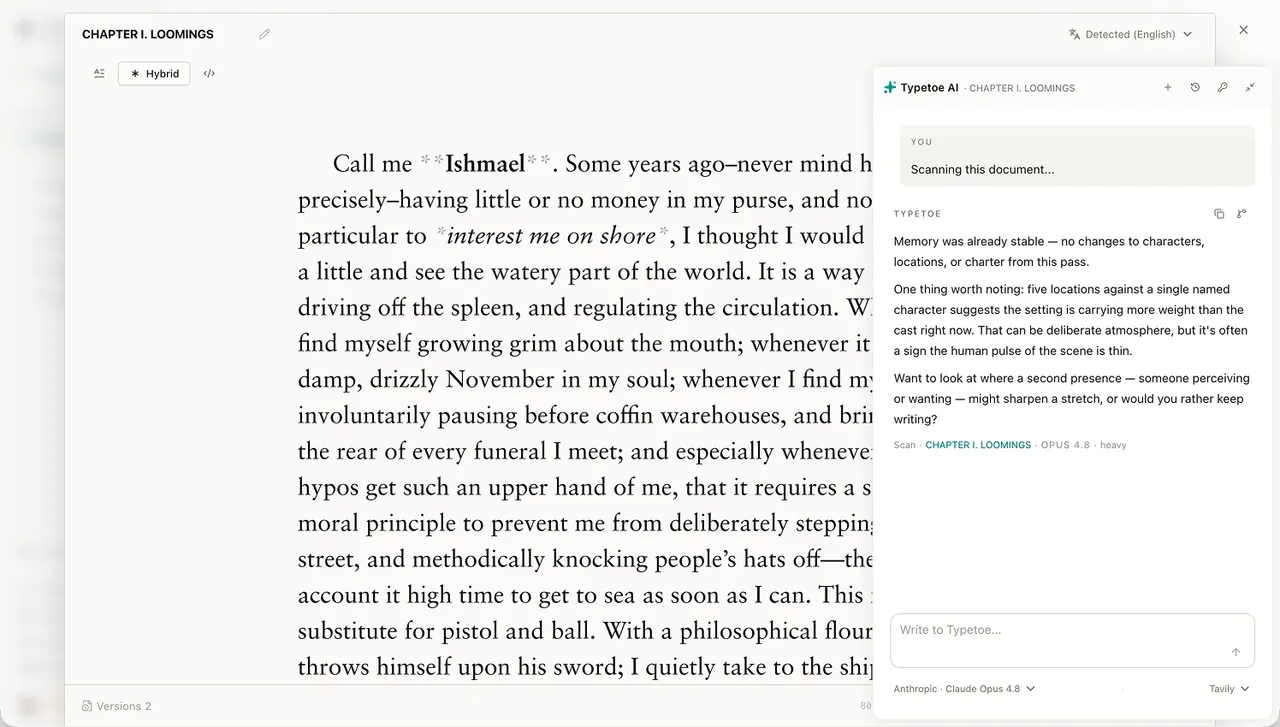
You
Scan this document…
Typetoe
Project memory now reflects the document’s central character, five locations, and four Charter elements.
◫ Typetoe guide
Ask how Typetoe works — the Scan, the Charter, importing a manuscript.
Ask Typetoe anything — free preview…
Or bring your own key
Connect your own API key and switch models whenever you like.
OpenAI, Anthropic, Google and others — your sidebar shows a real-time estimate of token usage and cost, while Typetoe’s router alerts you whenever an action exceeds the threshold you set and asks for your approval before continuing. The flexibility of bring-your-own-key, without the surprise bill.
Works with


 and more
Settings
Artificial intelligence
Keys, models and source search. Your keys live in this browser’s settings, not in the project database. How it works
Providers
API Key
••••••••••••••••••••
Anthropic dashboard ↗
Or the one you already pay for
Already paying for Claude or ChatGPT?
Connect Typetoe to it and keep working in the chat you already use. It can search your project, read a chapter, check the story bible and write back into the manuscript — no key, nothing metered, nothing to set up beyond signing in. (It's the Model Context Protocol, if the term means something to you.)
You
Where does it mention a nose and a pipe, and who is it about?
Typetoe
The passage where a nose and a pipe appear together is in Chapter XXVII. Knights and Squires, and it’s about Stubb, the second mate:
“…that thing must have been his pipe. For, like his nose, his short, black little pipe was one of the regular features…”
Opus 4.8
Write to Typetoe…
Your manuscript is never used to train anyone’s model.
Readings
A first reader for the whole chapter.
An advanced reading sends a stronger model through an entire chapter and reports back the way an editor would: what works, what doesn't, and what the pages are promising the reader. Two come with every account, funded by Typetoe. The yearly plan adds two a month, and when you want more you can buy them in packs — bought readings never expire, and they stay with you even if you cancel.
- Chapter-level judgement, not line edits
- Reads against your Charter and story bible
- Funded by Typetoe — no API key needed
Readings
More advanced readings
Yours to keep — they don’t expire, and they stay if you ever cancel.
Export project
Ownership
Your work stays yours.
Export any document or whole project to PDF, DOCX, ePub, Markdown, HTML, or a re-importable ZIP — anytime, on any plan. Send automatic backups to your own Dropbox. No lock-in, and no read-only jail if you ever stop paying. Your manuscript is yours to take with you.
Always on your command
An editor, a librarian, a reader, an advisor. An amplifier of your creativity.
Typetoe's AI does the quiet work. As an editor, it looks at the project, summarizes what matters, and brings unresolved issues to the surface. As a librarian, it knows the entire project and workspace — so you can simply ask it to help you use the app: create a character sheet, find where you mentioned a place, check your Charter, open the right document, or start a document and draft it. It uses the tools on request; the helm stays in your hands. And with the Charter, you set the rules it must always follow: point of view, tone, forbidden words — anything.
Typetoe AI
Where did I first mention Venice?
In Chapter III, “The Lagoon” — Thérèse recalls her honeymoon. It also appears in your Locations card Venice, 1911. Shall I open it?
Yes — and add a note that the bridge scene moves there.
Done. Note added to Venice, 1911.
Charter · Rules the AI always follows
The author stays at the center.
There are two ways to put AI in a novel. This is ours.
| Generative AI writing tools | Typetoe |
|---|---|
| Generates prose from a prompt | Takes in your material and puts it to work |
| You fill the story bible by hand | The AI proposes entries; you approve them |
| One bundled price, and no way to see inside it | Ours, or yours, or your own key — and always shown |
| Your work may train their models | Your manuscript never trains anything |
| Read-only access if you cancel | Export everything, anytime, forever |
| The AI supplies the words | The AI supplies the reading |
A quiet place to write — in your language.
Typetoe speaks English, Spanish, French, German, and Italian from the start. Not just the buttons: the interface, the AI’s answers, and the help all follow the language you write in. Long-form writing is intimate work — it should happen somewhere that feels like home, not somewhere you’re translating in your head.
If something doesn’t sound natural to you, let us know — Typetoe’s words, like its features, are still being shaped together with the people who use it.
Typetoe was born because I needed a first reader. Someone impartial and honest, who had genuinely read every draft, remembered every character — and was available at two in the morning. I couldn't find one, so I built one. Writing in the age of AI doesn't mean letting AI take your place. It means learning to use another tool of the trade, and guiding it with intention to give shape to your own creativity.
— the writer behind Typetoe
P.S. — Typetoe is young, and shaped by the writers using it now. If you find anything confusing, missing, or unnecessary, tell us. The roadmap is listening. feedback@typetoe.com
Built for long, complicated stories.
Novelists
Consistent across months
Keep a whole novel — characters, threads, decisions — consistent across months of drafting.
Worldbuilders
A universe, connected
Hold an entire universe of places, rules, and lore in one connected, searchable memory.
Non-fiction & memoir
Sources that hold
Track sources, facts, and structure across a long manuscript without losing the thread.
How Typetoe works
01
Write
Draft in a calm, focused editor. Distraction-free, autosave, versioning.
02
Let it read
Typetoe scans your work and proposes characters, places, rules, and to-dos.
03
Approve
Keep what’s right, dismiss the rest. Your project’s memory takes shape.
04
Continue
Months later, pick up exactly where you left off. Nothing forgotten.
Apps
Three apps.
One memory.
A native Mac app for the long sessions. iOS for the lines that arrive when you're nowhere near a desk. The web when you're on someone else's machine. Same library, same story bible, same account.
Web · any machine
Nothing to install
Sign in from a borrowed laptop and the whole project is already there — same drafts, same characters, same Charter.
Open the web appEvery OS (opens in a new tab)macOS · native
The desk for deep work
A native app for the hours you actually write in — your projects open locally, the editor quiet, the whole story bible a keystroke away. Apple silicon only, signed and notarized by Apple, so it opens without a warning.
Download for macOSApple chipiOS · iPhone & iPad
Your library, pocketed
Search any chapter, catch a line before it goes, look a character up mid-conversation. It's on the desk when you get back.
Get it on the App StoreiPhone & iPad (opens in a new tab)Pricing
Free to write. Pro at 59/year $49 your first year.
Start free, and stay free as long as you like. Pro is there for when one novel becomes many.
Free
$0/ forever
- The full writing experience
- 2 projects
- No credit card
- 25 AI questions to start — no key needed
- Two advanced readings, on Typetoe — they unlock once there is enough of your book to read
- 10 scans a week, 150 a year — the count starts over every twelve months
- Each scan fills your story bible: characters, places, and your Charter rules
- Add your own key when you want more — any provider, down to the cheap models
Pro
$49/ year, taxes included
Your first year — then $59/year.
$5.99/ month, taxes included
Billed monthly, cancel anytime. The yearly plan costs 18% less and includes two advanced readings a month.
✓Two advanced readings a month — a top model reads a whole chapter: what works, what does not, what it promises the reader
✓Top up whenever you want — packs of five or ten; bought readings never expire and are spent last
✓Top up whenever you want — packs of five or ten; bought readings never expire and are spent last
✓Every novel, series, and side-story — unlimited projects, all connected
✓200 scans a week — up to 5,000 a year, on Typetoe, however you connect your AI
✓Nothing is ever lost — every draft kept; return to any version, any day
✓Backups to your own Dropbox — your work, in your hands
✓macOS and iOS apps included — write on the sofa, pick up at the desk
✓Cheaper by the year — 18% less than paying by the month
✓Month by month — cancel anytime, no yearly commitment
One subscription instead of a writing app, a story bible, and a backup tool.
Your work, your key, your voice — always. Typetoe never trains a model on your manuscript. On every plan, forever: export everything, anytime. No read-only jail.
Questions writers ask
Does Typetoe write my novel for me?
Typetoe is first of all an editor, an archivist, your first reader and advisor — the discreet amplifier of your creativity. It reads your manuscript, keeps track of your story's details, and helps you stay consistent, untangle knots, beat the blocks, and keep your flow.
Do I need my own AI key?
No. Every account gets AI on Typetoe: the scans that build your story bible out of your own text, 25 questions to get started, and two advanced readings. Pro raises the scan allowance, and the yearly plan adds two readings a month. A key of your own is for when you want more, or a particular model — OpenAI, Anthropic, Google and others, switched freely, with the cost of every request in the open. Or connect the Claude or ChatGPT you already pay for and work in the chat you already use: no key, nothing metered.
What is an advanced reading?
The strongest model Typetoe has reads a whole chapter and tells you what works, what does not, and what the pages are promising the reader. Not a rewrite and not a score — a first reader's report on your own text. Typetoe pays for it, so your key is neither needed nor used. Two come with a new account, and the yearly plan adds two a month. If you want more, packs of five or ten can be bought at any time: bought readings never expire, they survive cancelling, and they are spent last — after the ones your plan already gave you.
Is my manuscript private?
Your work is yours. It is never used to train any AI model, and you can export or back it up to your own Dropbox at any time.
Can I get my work out?
Always. Export any document or project to PDF, DOCX, ePub, Markdown, HTML (also from the mobile app), or a re-importable ZIP — on any plan, with no lock-in.
What can the AI actually do?
Put it to the test: it reads your manuscript, tracks the details, flags the problems. It sees your whole project and knows the app, so you can ask it to add a card, find a mention, suggest a way forward, check your Charter, or move around the workspace.
What languages does Typetoe support?
English, Spanish, French, German, and Italian, from day one — interface, AI answers, and help all follow the language you choose, so you can write somewhere that feels like home.
What kind of writing is it for?
Long-form fiction above all — novels, series, worldbuilding-heavy stories — and any long manuscript where keeping track of details over time is the hard part.
Does my feedback actually change anything?
Yes. Features, languages, and even pricing are being shaped by what early writers ask for. Write to feedback@typetoe.com, or use the feedback button inside the app.
Your writing evolves.Your memory shouldn’t fade.
Start writing free — and help shape what Typetoe becomes. No credit card, no time limit.
Start writing free (opens in a new tab)